
Verse 9
Re: Verse 9
 by boogieman » Wed Apr 04, 2007 5:12 pm
That's what I was hoping for. The pond would be out of site from behind the wall, right?
When you come to a fork in the road, take it.
Yogi Berra
Yogi Berra
-

boogieman - Watson

- Posts: 882
- Joined: Fri Dec 17, 2004 5:45 am
- Location: Central New Nersey
Re: Verse 9
by fox » Wed Apr 04, 2007 5:46 pm
Behind the PDL statue intrigues me. Could we get to this location following the clues? Think about the Cleveland find...it was Behind a well recognizable site in the park that would stay there. Yes, trees are pretty permanent but a large concrete structure will always be there and has no roots.
for me...I like either this statue or around the obelisk...

for me...I like either this statue or around the obelisk...
Thank you for this adventure BP.
-
fox - Adler

- Posts: 2125
- Joined: Tue Jul 31, 2001 10:53 pm
- Location: amongst the cacti
Re: Verse 9
by Sawdusty » Wed Apr 04, 2007 6:06 pm
Boogieman, yes, you would be out of sight of the duck pond.
- Sawdusty
- Watcher

- Posts: 31
- Joined: Thu Feb 17, 2005 4:25 pm
Re: Verse 9
by Sawdusty » Wed Apr 04, 2007 6:23 pm
I want to try and send you some links to the Florida Memory Project that has old photo's of the Fountain of Youth. These show the ponce statue over different years. It was a very brushy area.
http://fpc.dos.state.fl.us/prints/pr19881.jpg
http://fpc.dos.state.fl.us/commerce/c001215.jpg
There was a fellow hired during my time at the park who really liked cutting out brush who cleaned out that whole area from the back corner all the way up to the statue.
http://fpc.dos.state.fl.us/prints/pr19881.jpg
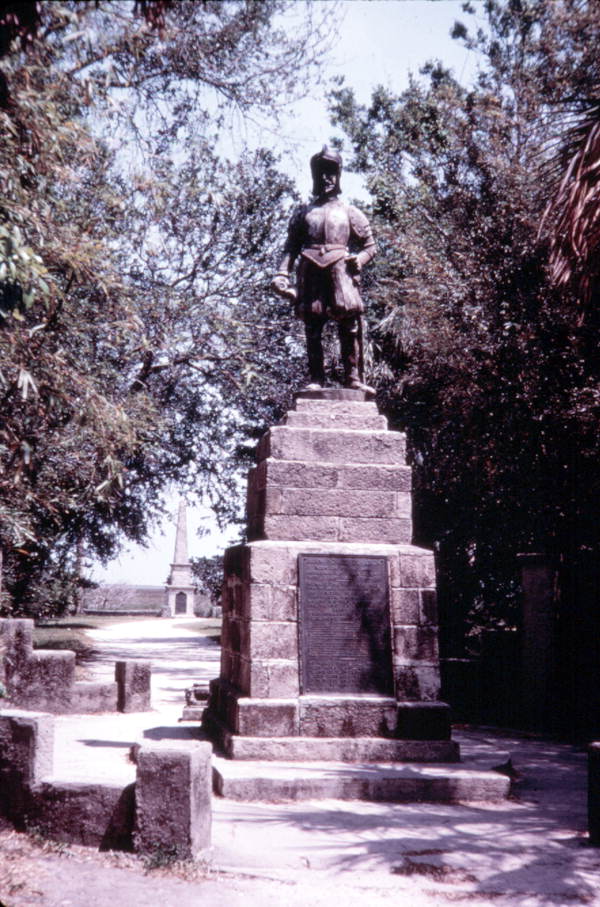
http://fpc.dos.state.fl.us/commerce/c001215.jpg
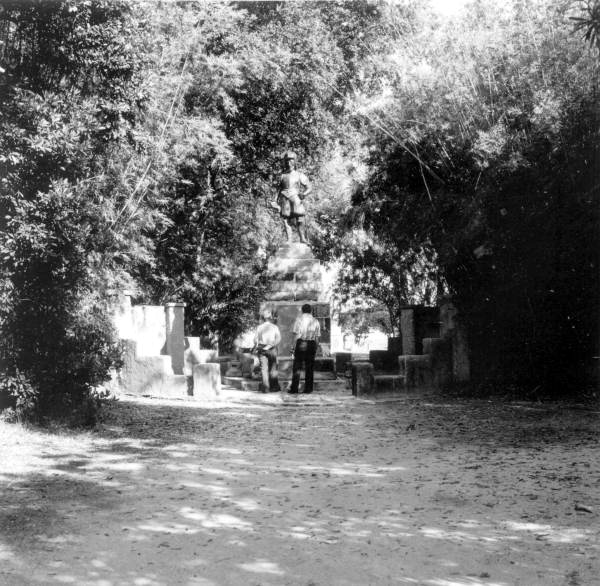
There was a fellow hired during my time at the park who really liked cutting out brush who cleaned out that whole area from the back corner all the way up to the statue.
- Sawdusty
- Watcher
- Posts: 31
- Joined: Thu Feb 17, 2005 4:25 pm
Re: Verse 9
by fox » Wed Apr 04, 2007 6:39 pm
thanks for the old pix Dusty... looking at them, I noticed that PDL (as seen from above) would also look similar to P6's banner emblem...a small square within a circle. Since Ponce is holding this banner in the P, wouldnt it be more logical that his statue at the park is the intended locale?
Thank you for this adventure BP.
-
fox - Adler
- Posts: 2125
- Joined: Tue Jul 31, 2001 10:53 pm
- Location: amongst the cacti
Re: Verse 9
by Trohn » Wed Apr 04, 2007 6:49 pm
fox wrote:thanks for the old pix Dusty... looking at them, I noticed that PDL (as seen from above) would also look similar to P6's banner emblem...a small square within a circle. Since Ponce is holding this banner in the P, wouldnt it be more logical that his statue at the park is the intended locale?
8)
haven't figured out why he is depicted on a horse,
unless it is part of the mythical global puzzle...
This has been previously stated, but now is a good time to restate it:
"Near Men
With wind rose"
Near men ----> could be referring to the two statues at this part o the park
(Ponde and the Chief)
With wind rose ---> (besides the obvious reference to the explorers)
I think I read/saw someone post that the duck/goose pond is
in this shape.
This would absolutely narrow the searching area, if true.
- Trohn
- Adler
- Posts: 1043
- Joined: Mon Feb 13, 2006 7:48 pm
Re: Verse 9
by Sawdusty » Wed Apr 04, 2007 7:03 pm
After discussions with the owner of the park, his pet theories are at the Indian Statue, at the Seloy marker, or against the wall of the park near the planetarium. Reasons are easy to get too, some things in the rock picture look a little like parts of the Indian statue, the Seloy clue, and BP's discussions in the front of the book, he seemed to like his natives. The wall at the back would be hard to pin down location...easy to dig at the Indian statue...all tiered, and hard to dig at the Seloy marker (we poked at that area with a probe and it is REALLY hard not to mention there are water lines buried there). For me, I think it might be at the big magnolia tree just inside the picket fence near the planetarium. There is another huge magnolia at the entrance to the spring house that is actually growing through the roof that would be my second choice. I hope it turns out to be a palm tree though cause I think it would be alot easier to dig at one of those!
- Sawdusty
- Watcher
- Posts: 31
- Joined: Thu Feb 17, 2005 4:25 pm
Re: Verse 9
by boogieman » Wed Apr 04, 2007 7:33 pm
Sawdusty wrote:There was a fellow hired during my time at the park who really liked cutting out brush who cleaned out that whole area from the back corner all the way up to the statue.
Wow. The park looks much much better cleared out. Was it cleared out in 82'?
The bending branches would be key here.
I think the first eight lines, up to the honking, can get you to Ponce.
The rest of V9 confirms the old village Seloy and FOY, thanks to Stercox. (and Jenny, she's a girl right? Sawdusty?)
Trohn, in the image, there is a big S under Ponce's butt. Look at it rotated to the left.
I can only get Saddle out of it. There is more there though. Different shading on the horse is curious.
Just thinking, the Chief didn't have wind rose. Just the guys that landed there. right?
Last edited by boogieman on Wed Apr 04, 2007 8:11 pm, edited 1 time in total.
When you come to a fork in the road, take it.
Yogi Berra
Yogi Berra
-
boogieman - Watson
- Posts: 882
- Joined: Fri Dec 17, 2004 5:45 am
- Location: Central New Nersey
Re: Verse 9
by regulus » Wed Apr 04, 2007 8:23 pm
WOW! This thread got popular really fast! Looks like we're gonna find two casques very soon!
And for my input, uh, this "tall" tree must be distinguishable from all of the others, once again another "tall" marker, too bad there isn't an S on the tree, LOL!
Great job everyone!
-Regulus
And for my input, uh, this "tall" tree must be distinguishable from all of the others, once again another "tall" marker, too bad there isn't an S on the tree, LOL!
Great job everyone!
-Regulus
There is more money buried in the earth than there is in currency today... I guarantee it.
-Edward Fitzgerald
-Edward Fitzgerald
- regulus
- Moriarty

- Posts: 217
- Joined: Wed Oct 19, 2005 7:21 pm
Re: Verse 9
by regulus » Wed Apr 04, 2007 8:38 pm
Check this out, I looked up tree in the dictionary,
def 3: something resembling a tree in shape, as a clothes tree or a crosstree
def 6: a pole, post, beam, bar, handle, or the like, as one forming part of some structure
there ya go!
-regulus
def 3: something resembling a tree in shape, as a clothes tree or a crosstree
def 6: a pole, post, beam, bar, handle, or the like, as one forming part of some structure
there ya go!
-regulus
There is more money buried in the earth than there is in currency today... I guarantee it.
-Edward Fitzgerald
-Edward Fitzgerald
- regulus
- Moriarty
- Posts: 217
- Joined: Wed Oct 19, 2005 7:21 pm
Re: Verse 9
by shecrab » Wed Apr 04, 2007 10:30 pm
Have you considered that "rose" may not mean flower/compass?
It may mean LIFTED--aloft.....
Near men, with wind, rose
Rose meaning greater. We often say 'the wind rose' meaning it swelled, got stronger.
OR...near men with wind ROWS---As in Row Row Row your boat....Or ROWS--of something--tiers, lines, levels. Plants. Rows of flowers. Rows of trees.
It occurred to me that both wind and rose can have multiple meanings. Wind might mean breeze, or it might mean to coil up, wrap around.
ck
"The telephone book is full of facts, but it doesn't contain a single idea." -- Mortimer Adler
-

shecrab - Adler
- Posts: 1040
- Joined: Wed Dec 27, 2006 11:50 pm
- Location: Ohio
Re: Verse 9
by Sawdusty » Wed Apr 04, 2007 11:20 pm
As of 2001 I would say that the area around the Ponce statue was still very brushy. I would not have tried to wander around in that area for fear of snakes and creepy-crawlers. You could not even see the water if you were standing to the left of the statue due to all the brush there. The right side was slightly better but not by much.
- Sawdusty
- Watcher
- Posts: 31
- Joined: Thu Feb 17, 2005 4:25 pm
Re: Verse 9
by Trohn » Thu Apr 05, 2007 2:34 am
I would like to propose that the "shell" in "shell, limestone, silver, salt"
is represented by the midpark fountain (of the water girl) the fountain is
shaped like three shells stacked on each other. It appears that the area
surrounding this fountain is of a white rock (i don't think they would have used marble)
so I am making the assumption that it could be limestone.
Just behind you (west) is the other side of the spring house and
the "silver salt cellar" (Both the artifact and the SELOY sign) support the second
half of the line.
Now, reading that the cellar is egg shaped (oval) I imagined that that could be also
described as a teardrop shape. (Like moonlight in teardrop) silver oval (the 'in' caps
the reasoning because of the hiding of the documents within the cellar.
So at this spot, facing east, you have Ponce Statue a ways in front of you,
you have the duck pond (wind rose shaped) close in front of you slightly to the right,
you have the chief just to the south, you are facing east and the gift shop is a little
ways to the north with the green fence behind it... you had to cross the same green fence
(get behind it) to get to this location.
And there are the rain pots also sitting here.
Next to the clay rain pots is planted high, yellow grass - I have no clue what the name of it is...
but it does match the last lines (Over the tall grass, years pass, rain falls)
See FOY tour photo 59/117 for a good shot of the direction I am referring to.
And there are benches here for BP to sit and ponder which tree to select.
There are many types of trees, but I noticed three distinctly tall, thin, leafless,
ones - esp. one behind the fountain -
And this location behind the fountain, has enough room between the base of the fountain
and the east side of the tree, for a hole.
Look, see, think.
- Trohn
- Adler
- Posts: 1043
- Joined: Mon Feb 13, 2006 7:48 pm
Re: Verse 9
by Trohn » Thu Apr 05, 2007 2:43 am
http://good-times.webshots.com/photo/28 ... 0493panrnP
Shot the the rain pots, the tall grass, the tall tree, the fountain base,
and the shell fountain - moving from fore ground to back ground in the
center of the attached.
http://good-times.webshots.com/photo/23 ... 0493zxFTLV
and the same area looking from the opposite direction.
Shot the the rain pots, the tall grass, the tall tree, the fountain base,
and the shell fountain - moving from fore ground to back ground in the
center of the attached.
http://good-times.webshots.com/photo/23 ... 0493zxFTLV
and the same area looking from the opposite direction.
- Trohn
- Adler
- Posts: 1043
- Joined: Mon Feb 13, 2006 7:48 pm
Re: Verse 9
by Pine_Tree » Thu Apr 05, 2007 3:13 am
My FOY visit story, quickly:
Memorial Day of 2005, the Tree family went to St. Augustine. We went through the park, and then I went into the gift shop and asked a few questions about old pictures, fences and such. Turns out I was talking to Sawdusty, who had already gotten involved with Stercox. We chatted, and she came out and walked around with us for awhile discussing The Secret. After awhile, she went back inside and I kept looking around, but later passed by her desk while happened to be on the phone with the owner of the park, who was leaving for a ski trip. She handed me the phone and we talked some. I explained the jist of the park theory, and told him I'd send it all in writing. He asked that I not post anything publicly for fear of getting folks digging uncontrollably in the park. By the way, ATT had just recently come out, and he was aware of it by virtue of people poking around in the knotholes of trees in the park and on Magnolia street. Out of respect for his request as the property owner, I agreed, and hence have not posted anything about St. Augustine since.
At the Milwaukee dig, Stercox described their planetarium theories, and I described what's below. Now that it's public, I can participate in this one again. So...
I think it's immediately South of the low tabby wall enclosing the obelisk. I didn't have that belief until after the trip, studying maps and pictures.
P6: Picture yourself just SW of the PDL statue, looking up at it. I believe that this is the view represented figuratively in P6. The big rock with PDL atop it is the large pedestal of the PDL statue. Behind and beyond it, off to the right slightly, you see the obelisk with its wall around it. There are several trees just to the right of it, clearly visible in Stercox's photos. The far-away triangular rock in the P is the obelisk and its base. The tree in the painting is the "tall tree" from V9, and represents either a tall palm that is now absent, or the tallest of the remaining trees.
The emblem on the banner is the precise overhead view of the obelisk, and I believe it serves the same function as the image of the garden wall in the Cleveland find. It's a clear exact representation of a monument that you can be touching when you stand atop the casque site.
V9:
The first chapter
(Ver batim from the sign out front)
Written in water
(Not sure, but obviously nautical theme of discovery)
Near men
With wind rose
("Men with wind rose"="sailors". Near sailors means "get out there towards the waterside". You can see plenty of boats in Hospital Creek, past the marsh.)
Behind bending branches
And a green picket fence
At the base of a tall tree
(These three lines seem to be a final description of the exact location, and I believe they point you to spot just south of the round tabby enclosure. I do not believe this refers to the existing green fence against the marsh, which is obviously new. Rather, I believe it refers to the fence shown on the Archaeological Site Map, a close-up of which is in Stercox's pix at:
http://family.webshots.com/photo/220708 ... IlWq and
http://family.webshots.com/photo/283535 ... 0493vTJkqn
, and I’m obviously hoping this fence was green. This fence stretched roughly east-west, just south of the low enclosure, and some trees and bushes are evident in the overhead view. From my visit, there is no obvious “tall tree” south of the enclosure, but was there one in 1982, and was the fence green? If so, then I would look for the casque between the base of the tall tree and the low tabby wall. Also, "tall tree" may be a really tall palm, or it may just mean the tallest of the trees in this southern patch. A first alternate would be just south of the fence position, because we can’t really be sure how he interpreted the description of “behind” a fence. Knowing what the area looked like in 1982 would be helpful in interpretation.)
You can still hear the honking
(Geese, but you can hear geese for a good ways.)
Shell, limestone, silver, salt
(“Shell” and “limestone” are present on the sign defining coquina. “Silver salt” obviously refers to the now-absent salt cellar sign. By the way, I believe Mr. Preiss adopted the word “casque” from this sign.)
Stars move by day
(Planetarium at park)
Sails pass by night
(Not sure, but there are obviously lots of sailing ship pictures)
Like moonlight in teardrops
(I believe this is a reference to the oyster shells protruding from the eroded tabby wall. Moonlight=pearls, teardrops=salt water=sea, therefore oysters. In my theory, you can reach out and touch these oyster shells as you stand atop the burial site.)
Over the tall grass
(Reference to marsh grasses just behind the monument?)
Years pass, rain falls.
(My best guess is that this is another reference to the eroded tabby wall. The noticeable state of erosion is the result of years of rainfall.)
I know that several portions of this differ significantly from Stercox's theory, especially as pertains to the Planetarium. Anyway, that's my story.
Pine
Last edited by Pine_Tree on Thu Apr 05, 2007 3:33 am, edited 1 time in total.
- Pine_Tree
- Moriarty
- Posts: 149
- Joined: Fri Jul 09, 2004 6:46 pm
- Location: Georgia
Who is online
Users browsing this forum: Google [Bot] and 24 guests